
A no-slop guide to AI image generation in affiliate marketing
28 JAN 2026
With AI image generation tools like Nano Banana Pro becoming the latest hype, how should affiliates integrate them into their content pipeline? Jani Peteri, senior iGaming UX creative and AI specialist, writes exclusively for iGBA about common misconceptions and how to generate images that add real value to affiliate sites.
Users don’t read first. They skim, then they judge. On iGaming affiliate sites, that judgment happens in seconds, often before users process headlines or bonus offers. A single image can be enough for them to decide whether a site feels credible or sketchy.
AI-generated images are now everywhere and have made their way into affiliate marketing. Some improve clarity and consistency. Others signal low effort, low trust and low intent, often because of poor prompting or creators simply not caring enough – users can tell the difference immediately.
Not a lazy shortcut
The real issue isn’t AI. It’s how carelessly people use them.
Many sites use AI images just to generate something fast. Fantastic – this way, you save time, and there’s no need to hire a professional graphic designer. But upon closer look, the site might end up looking cheap.
If they’re greeted with low-quality or irrelevant AI images made just to fill space, it triggers the same reaction as reading a weak copy or generic content
Jani Peteri
This is especially a risky strategy given how quickly users make their decisions. They arrive alert and actively scan for signals of credibility, good offers and real value. If they’re greeted with low-quality or irrelevant AI images made just to fill space, it triggers the same reaction as reading a weak copy or generic content that feels cheap, automated and disposable.
When a site already feels automated, users may assume the advice is, too.
When AI images actually work
AI-generated images can improve many aspects of affiliate UX and UI when used properly. The key difference is whether visuals support the user journey and the message, or just take up space. As a rule of thumb, images should always support the content.
Here are some ways AI-generated visuals could level up your site design:
- Editorial-style sports visuals: With good quality prompts, you can create incredibly accurate editorial-style images like full body shots, close-ups or wider scenes. There are no limits, only bad prompts.
- Consistent icon systems: A strong affiliate site should already have brand rules, colour palettes, typography and tone in place. In this case, icon prompting becomes easier and more effective, as the outputs fit into an existing visual language rather than clashing with it. This consistency is a powerful trust signal. It shows users that the experience was designed deliberately, not thrown together.
As a rule of thumb, images should always support the content
When AI images become slop
Signs like unnatural facial expressions or odd proportions alone can trigger negative reactions from users. People are tired of looking at lazy AI slop that feels cheap. However, development in the AI space is moving fast, and tools like Nano Banana Pro may soon make it almost impossible to tell what’s real and what isn’t.
Another common issue is style mismatch. When a site has little or no brand identity, AI images tend to default to generic, over-rendered visuals. They look unmistakably artificial. Combined with thin or templated content, this reinforces the impression that the site was built in a rush with little care.
That’s a crucial point for affiliates to understand. A strong brand foundation makes it much easier to apply AI visuals strategically. You have control and can produce quality images and visuals with intent and precision.
A weak brand foundation, in contrast, makes AI images feel scattered. Without a clear visual identity, an AI image only highlights everything that isn’t working. If it doesn’t add clarity to your brand, it adds confusion.
When a site has little or no brand identity, AI images tend to default to generic, over-rendered visuals
Jani Peteri
A simple creators’ guide
Ask yourself before generating any image: what decision is the user making at this point, and will including an image or icon make that decision clearer? If the answer isn’t obvious, you might not need an image at all.
But if an image does add value, then it’s time to prompt properly.
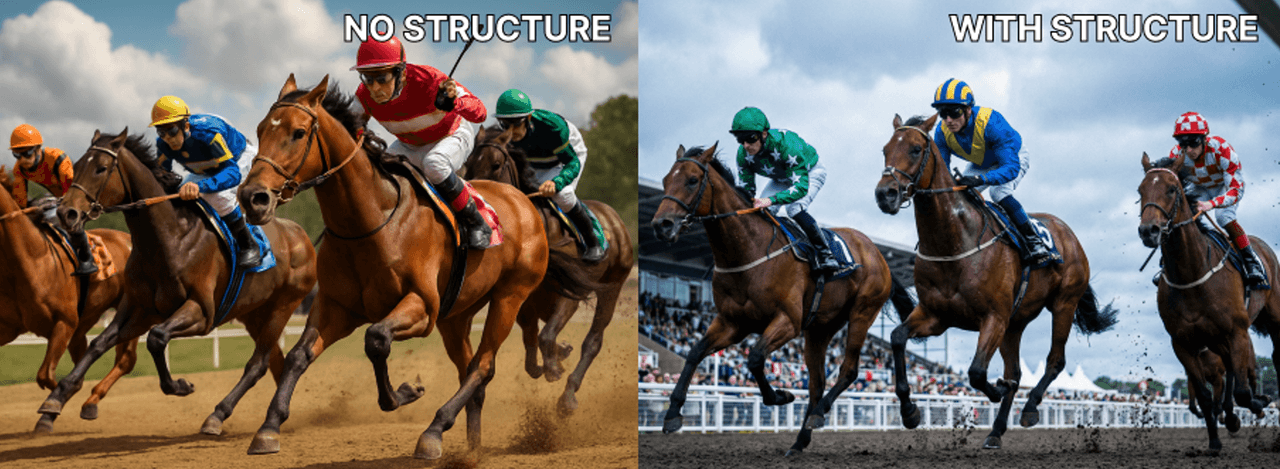
The first step is structure and control. If you need a sports image from a racetrack and prompt something like “Exciting image of jockeys riding horses at a race track,” tools like Nano Banana will give you decent results, but the composition will be random.
If you want control over how many jockeys there are, the camera angle, colour tones, time of day, or whether it’s sunny, cloudy or rainy, you need much more precise prompting. Here is an example of how to structure an image prompt.
- Mood & art direction: Dynamic, exciting, high-intensity action with a documentary sports aesthetic
- Subjects: Three male jockeys in different colourful racing silks, mid-race, crouched forward in riding stance with focused expressions, mounted on galloping racehorses in full stride
- Image type: Editorial sports action shot
- Shot & composition: Low-angle action shot with wide framing, front-to-diagonal perspective capturing the three horses and jockeys in motion, shallow depth of field with slight motion blur, dramatic lens compression, shot on a 50mm lens
- Scene & environment: Outdoor racetrack, dirt surface kicking up from hooves, stadium stands and race barriers in the background, overcast sky
- Lighting & tone: Natural daylight under cloudy conditions, diffused lighting with soft shadows, cool blue colour grading, slight film grain to enhance realism, fast shutter feel
- Details & texture: Earth tones from the track, glossy coats on horses, tension in leg muscles and reins, flying dirt particles, sharp contrast between colourful racing silks and the muted environment
When creating icons, the same logic applies. You need to define the style first. Is it three-dimensional, flat/ two-dimensional or a line icon? How many colours do you need? Once that’s clear, you can build a consistent icon prompt style.
What AI reveals
AI-generated images don’t ruin affiliate sites. They only expose unclear branding, weak UX thinking and content designed for volume rather than decisions.
For affiliates willing to approach AI through a UX and behavioural lens, this can be an opportunity. When used with restraint and intent, AI visuals can improve clarity, consistency and trust. When used lazily, they risk quietly pushing users away. The choice is yours.

Jani
Peteri
Jani Peteri is a senior creative lead with over 15 years of experience in iGaming, working for both operators and affiliates. He has led design & creative and UX/UI from early-stage start-ups to global organisations with a focus on clarity, execution and results.