

Advance warning: Google's page experience update
15 JUL 2020
That Google chose to warn now of the impacts of an algorithm update that won’t take full effect until 2021 indicates just how important a staging post this will be in its drive to ensure user-friendly sites win out in the rankings.
Google’s insistence that website owners should focus on quality of content and superior user experience has not always rung true. Of course, the search giant is keen to discourage manipulative tactics, but the fact remains that it hasn’t always been the case that the best, most user-friendly sites would outrank those adopting sneakier tactics and illicit quick wins. However, in May 2020 Google made quite
a transparent postabout how page experience will become particularly important – and it’s time to pay attention. This shift is so fundamental that Google has taken the step of warning that the full extent of changes will not be rolled out until 2021. Next year might seem a while away, but webmasters need to become more informed about what constitutes page experience, and the aspects they control.WHY PAGE EXPERIENCE? WHY NOW?
While desktop page speed was announced as a significant focus for Google as far back as 2010, few SEOs at the time were ditching their usual tactics to focus on site speed. Similarly, though Penguin and Panda certainly caused some rethinks, a lot of the key elements of growing a site’s rankings and traffic have remained the same – depth of content, a deliberate focus on site structure/headings/anchor text and the right quality and quantity of inbound links.
However, developments of recent years can’t be ignored with the move to the mobile-first index and successive broad core updates refining how the algorithm evaluates, ranks and rewards meaningful content.
The BERT update from late 2019 has been another step in this direction with Google stating that the update was “oriented around improving language understanding, particularly for more natural language/conversational queries, as BERT is able to help Search better understand the nuance and context of words in Searches and better match those queries with helpful results.”
What this means is that Google can apply much greater understanding of context and meaning when deciding on rankings.
As such, Google is in a much better position to evaluate whether onsite content is answering meaningful questions efficiently with well-structured and logical content, or if someone has just jammed a lot of material together and relied on strong domain authority or brand power to deliver visibility.
With the addition of special focus on what Google is calling ‘Core Web Vitals’ – metrics around speed, technical infrastructure and usability – there’s now a wide range of quality factors that Google is measuring to present users with web results that will give better answers and seamless experiences.
These factors will be added to but are expected to include:
- Loading and speed
- Visual stability and efficient display of on-page elements
- Interactivity and accessibility
- Potentially engagement metrics such as time on site and bounce rates
A BETTER WEB – PAGE EXPERIENCE AS RANKING FACTOR
The stated aim of Google is as follows: “We will introduce a new signal that combines Core Web Vitals with our existing signals for page experience to provide a holistic picture of the quality of a user’s experience on a web page.”
Page experience is a catch-all term to describe the various ways engagement and user satisfaction can be indirectly measured, given that Google can’t (yet) read the minds of users.
Google being open about focusing on what is measurable is good news for webmasters and SEO professionals as if Google canmeasuresomething, we can develop ways tomanageit.
We already know that site security, speed, mobile responsiveness and more are factored in, but the latest news from Google indicates a broader range of measures will be factored in and – more good news – they’ll let us know what those factors are.
However, will igaming stakeholders be equipped to take action?
IGAMING IMPLICATIONS – END OF THE LINE FOR UNDERPERFORMANCE
In gaming, although a lot of promotional material is released talking about innovation in product and platform development, I think it’s fair to say that there’s been a lack of creativity and customer focus in many areas. Few platforms are built with SEO in mind, and KYC breaches and CRM missteps are frequent news. Content is repetitive and undistinguished. Specifically, in the current Covid-19 era, some gaming brands and their affiliates have come under fire for opportunistic promotions that are in breach of regulation or are just plain tacky. With a certain proportion of the igaming landscape always looking for the quickest shortcuts and rapid-fire wins, there is an institutional lack of focus on long-term quality in many quarters. As such, there are big opportunities for those who willtake Google’s guidance on board to deliver qualitatively better experiences focused on engaging customers in positive ways.PAGE EXPERIENCE AND PLAYER ENGAGEMENT
Because we’re in an industry with enthusiastic players, UX considerations are not always front of mind – players will find a way to play, fans will find the content that is most relevant to their passions and so on. More significant still are considerations about how visitors can experience your content in more dynamic ways. In-play betting content including live prompts, stats and data feeds has become increasingly sophisticated – and enjoyable – but for many platforms implementation and development time are required. On the casino side of things, there’s huge scope to improve how games are served, funds are deposited, and sign-ups are processed. At every step there are opportunities to answer questions and build confidence that drives profitable action. According to Google: “Great page experiences enable people to get more done and engage more deeply; in contrast, a bad page experience could stand in the way of a person being able to find the valuable information on a page.”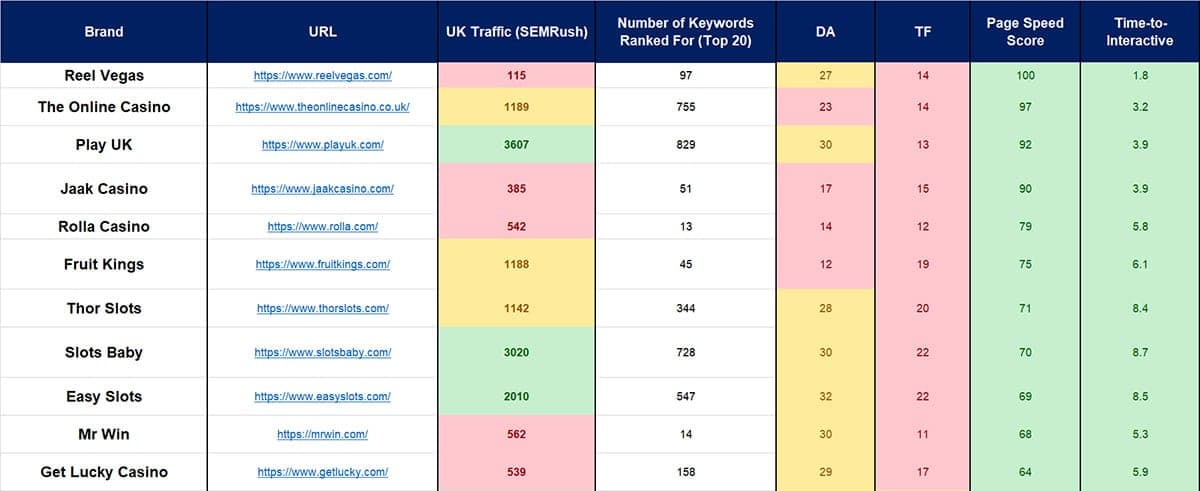
Affiliates have some advantages as they don’t have the complex platforms that operators deal with but nevertheless, many affiliates have become accustomed to spinning up sites with the goal of getting as many casino/bookie reviews live as possible.
Focusing on the quality of content will become critical as with BERT and further innovations around understanding site content Google will be able to differentiate between what often looks like an undifferentiated mass of sites saying much the same things about much the same topics.
Sites should be treated as functional resources not repositories of content.
To this end, website owners can focus on:
- Content that is easy to consume – not just comprehensive
- Design that is responsive, fast and accessible – not just pretty
- Navigation, site content, visuals and interactive elements that make life easier – not harder – for visitors
MEASURE TO MANAGE – FREE RESOURCES
Most site owners will be familiar with tools such as Lighthouse and PageSpeed Insights that give you data on Google’s assessment of site performance, but further Core Web Vitals information will be found in Google Search Console. To be fair to Google, Search Console has been fairly consistent in providing actionable information to webmasters that perhaps isn’t always as valued as it should be. Measures like bounce rates, time on site, page views and user behaviour more generally (are they clicking around unable to take an action they want ?) become more important not just to maximise conversions, but to justify your rankings. Page experience will continue to be only one aspect of search engine performance but with updates and guidance coming with increasing frequency from Google, it really is time to prioritise. AsSistrixhelpfully pointed out, there’s a lot of written resources directly available from Google including:While igaming isn’t one of the chosen verticals listed, it’s certainly possible to collate a view of UX that is focused on answering audience queries in the most efficient way possible, and aligning content, the rendering of information and speed to make it happen. The Google view of the world is that a good experience isn’t necessarily what your brand manager or CEO thinks. Breathless web copy or ‘unique’ navigation features are not the things to aim for. Functionality, speed, use value and clarity are. As ever, you don’t necessarily have to agree with what Google emphasises as being the key aspects of page experience – but you do have to apply it to build an SEO strategy focused on future growth.
MARTIN CALVERTis marketing director for content, translations and digital marketing firmICS-digital, which works across 68 languages and 80 territories. Prior to joining ICS in September 2019, Martin spent three-and-a-half years as marketing director at Blueclaw.