

Brazil 2026: What news publishers’ SERP takeover means for affiliates
27 MAY 2026

In part one of the ultimate affiliate SEO guide to Brazil in 2026, Martin Calvert, marketing director at ICS-digital, along with three LatAm industry experts, explores the market’s regulatory backdrop, the dominance of news media in the SERPs, common localisation mistakes and the sizable unhappy customer cohort that could present an opportunity for detail-oriented affiliates.
It feels like a lot has happened since my last article for iGBA about the Brazilian market - it's now live, regulated and already competitive with an element of hype that seems to rise and fall often.
In SEO terms and marketing more generally, the scale of the opportunity, trust factors and the form the regulated market is taking have had a direct impact on how organic customers search, the real estate on the SERPs where brands can be visible and how much room affiliates realistically have.
In our Argentina piece last year, the picture shows a market that still feels pretty open, with fragmented provincial regulation, strong demand and enough inconsistency among the major players that affiliates can make progress against larger competitors through persistence, customer-centric content and above-average localisation.
Brazil is different, with some significant challenges, particularly as affiliates aren't just competing with operators, but with national media as well.
As we've seen in the regulated states in the US, this can shift the shape of the SERP quite quickly. This isn't to say that it is impossible for affiliates (and smaller operators) to compete, more that there is significant scope to burn time and budget and put in lots of effort for less reward in a less forgiving market.
Brazil is different, with some significant challenges, particularly as affiliates aren't just competing with operators, but with national media as well
Martin Calvert, ICS-digital
Before going further, I need to thank Brazil-market experts Lorena Vieira from Big Daddy Games, Sei Kato from ICS and Jaime Moscote from Testa for sharing their insights exclusively for this piece.
As their insights and available data illustrate, the usual "operators are dominating" narrative we hear in newer markets doesn't quite stand up in 2026.
As anyone who has spent a bit of time in the Brazilian SERPs will observe, a different picture has emerged.
Regulatory state of play
This picture is at least partially shaped by the regulatory backdrop no longer being in (much) doubt, opening the doors for all sorts of publishers to talk about betting and gaming, while clearing the deck of some who had got an 'early start' in the market.
The Ministry of Finance and Anatel have reportedly blocked over 39,000 unregulated sites and removed 200+ unlicensed apps between them, while the SPA has opened well over 150 enforcement proceedings against dozens of operators and brands.
With the grey market under scrutiny (and debatably shrinking), this has shaped the types of deals affiliates can make, with whom, and the available marketing methods partners will accept.
What many international companies underestimate is that betting was culturally taboo for decades
Lorena Vieira, Big Daddy Gaming
Lorena Vieira, business development manager at Big Daddy Gaming, adds a cultural dimension that's easy to overlook:
"What many international companies underestimate is that betting was culturally taboo for decades. For a long time, Brazilians associated gambling with something illegal, risky or morally questionable, while state lotteries operated under Caixa Econômica Federal became the accepted form of betting.
So entering Brazil is not just about acquiring players – it's about rebuilding the perception of betting itself. Credibility in Brazil requires education, transparency, responsible gambling messaging and local cultural sensitivity."
That cultural backdrop helps explain why trust signals matter so much in Brazilian SERPs and why news media brands have been so well-placed to capitalise.
News media brands in Brazilian SERPs
The intuitive assumption with any newly regulated market is often that big-budget licensed operators will hoover up organic visibility. In Brazil, that's only partly true.
Based on May 2026 Semrush analysis of the current top 10 organic results (which, as ever, will shift slightly by location and device) for three of the biggest commercial queries in Brazil – "casas de apostas" (betting sites), "apostas online" (online betting) and "cassino online" (online casino) – the dominant force isn't operators but mainstream Brazilian news media.
For "casas de apostas" specifically, the top 10 contains five news/media domains, three operators, one government site and Instagram. Zero pure affiliates. Correio Braziliense, Gazeta Esportiva, Brasil247, Gazeta do Povo, Trivela, Metropoles, Lance and Placar have all built dedicated apostas verticals on the back of existing domain authority and editorial output.
Entertainingly, the betting section is effectively a side project of a major sports newsroom, not a dedicated competitor… and it's still winning
Martin Calvert, ICS-digital
Gazeta Esportiva pulls roughly 4.7m monthly organic visits across its top 100 ranking keywords, and only around 315k of that comes from its /apostas/ vertical.
Entertainingly, the betting section is effectively a side project of a major sports newsroom, not a dedicated competitor… and it's still winning.
Over the last 12 months, Trivela appears to be up around 52% year-on-year and continues to climb. Betfair's main BR domain, by contrast, seems to be down around 26% on the same period despite remaining one of the highest-traffic operator domains in the market.
The split is fairly stark, with news verticals accelerating and some of the biggest operators slowing down.
There's also an intriguing detail here in how news media is monetising operator brand searches. Gazeta Esportiva ranks on page one or page two for "bet365", "sportingbet", "betfair", "betano", "kto" and "esportes da sorte", capturing review and comparison traffic on each operator's own brand term.
All of this underpins why agencies like ICS-digital recommend and carry out digital PR and link acquisition campaigns, for betting brands to build up the trust and the attributes/features of 'major', trusted brands. But we can't ignore that these big publishers have that advantage from the outset.
They already have the editorial authority to rank well and earn trusted clicks for commercial keyword queries at the point where potential bettors are looking for reliable answers.
In markets with a strong and trusted media landscape, betting firms need to attempt to close this gap at least partially, particularly in the age of AI when external validation and links are so key to being cited.
That said, the picture shifts a bit by vertical. Sei Kato, SEO market growth specialist at ICS-digital, points out that casino queries tell a bit of a different story:
"The SERP for 'cassino online' shows that - while Betsson's BR-specific subfolder ranks #1 - positions #4, #5, #8, #9 and #10 are filled by affiliate 'top 10' style posts. That's roughly 50% of the SERP for 'cassino online' being filled by affiliate posts. The caveat is that there are no 'fresh' domains with a DR under 40, which suggests backlinks and digital PR are still propping affiliate sites up and keeping them competitive."
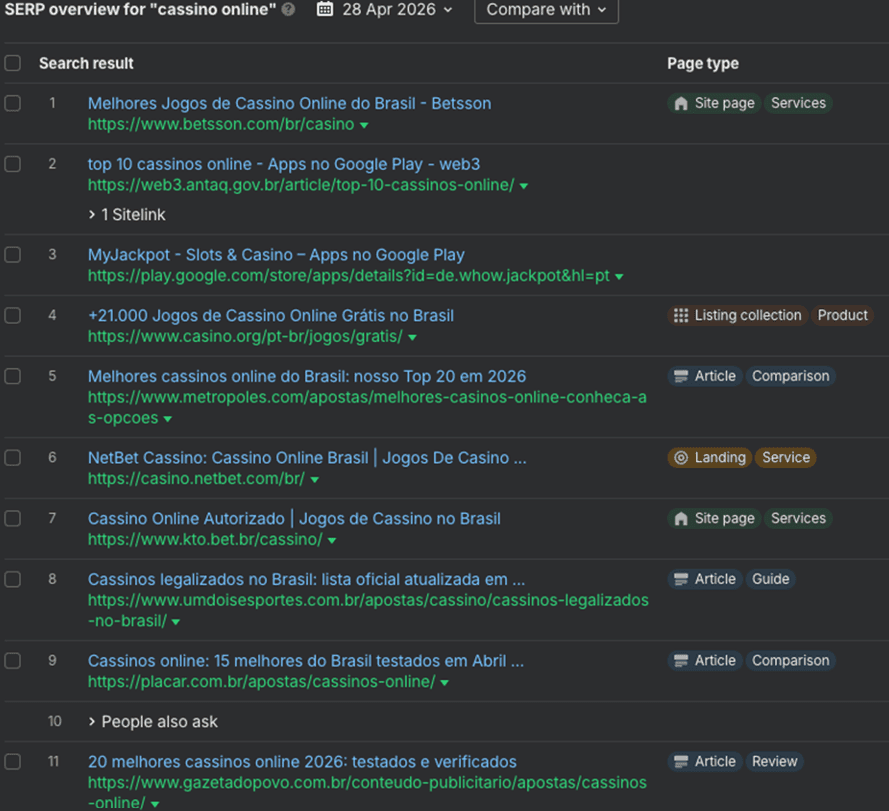
Ahrefs SERP overview for "cassino online", 28 Apr 2026
So while sportsbook head terms tend to be dominated by media, casino queries seem to remain more affiliate-friendly, provided the off-site SEO foundations are there
Martin Calvert, ICS-digital
So while sportsbook head terms tend to be dominated by media, casino queries seem to remain more affiliate-friendly, provided the off-site SEO foundations are there.
This isn't only a challenge/opportunity for affiliates. The operator picture also deserves a closer look.
Betfair's main BR domain pulls roughly 2.0m monthly organic visits, which sounds formidable. However, around 80% of that appears to be branded traffic, with the keyword "betfair" alone accounting for nearly three-quarters of the total.
The non-branded layer, where affiliates and editorial content actually compete, is closer to 300k.
This is still enormously significant and presumably highly profitable, but it reframes things in terms of the market opportunity. Operator SEO in Brazil isn't (at present) defined by brands fighting it out for non-brand keywords and winning generic head terms, but in having a strong enough brand that people search for you directly.
We could debate whether this is a case of operators investing in brand-boosting strategies like banner and OOH advertising, endorsements, influencer partnerships and sponsorships leading to brand search being so high rather than something intrinsic to the market.
Regardless, most newer entrants don't have anything close to this name recognition, and realistically, many won't get there quickly – which is helpful if you're Betfair – less so if you're trying to rank against them.
For affiliates, this challenge to target top keywords and money terms in Brazil mostly comes down to fighting for what's left after news media has taken a good portion of page one.
The opportunity (at present at least) is in long-tail commercial, comparison and intent-led queries where editorial sites haven't built proper depth yet.
All of this isn't necessarily bad news, though it does mean affiliates with finite time and budget in particular need to consider where to devote their attention, avoid 'fatal half measures' and hone in on SEO (and marketing) methods where they are most likely to see a return.
The opportunity (at present at least) is in long-tail commercial, comparison and intent-led queries where editorial sites haven't built proper depth yet
Martin Calvert, ICS-digital
Localisation: underwhelming translation limits opportunity
One of the points in our recent piece on the Argentinian market was that translation alone isn't enough. That still feels true here, but the timeline is more compressed in Brazil.
Portuguese (of course) isn't Spanish, and Brazilian Portuguese isn't Iberian Portuguese. Affiliates running Spain or Portugal-localised content into Brazil with light edits get caught quickly.
The vocabulary diverges in places that matter: "apostas desportivas" (sports betting – Portugal usage) reads as foreign, whereas in Brazil it's "apostas esportivas”.
These may be charitably called small slips, but it is a very easy way to gain or lose trust in a market where we see incumbent media outlets and international operators win based on trust signals and brand power.
The phrasing of head keyword terms is also settled. Brazilians search "casas de apostas" (betting sites), not "sites de apostas" or "apostas online" interchangeably. The volume sits decisively on "casas de apostas" and its variants.
For international affiliates, it is important to put prior knowledge (and ego) to one side and build keyword sets from PT-BR SERPs first. Don't infer them from English data, and don't rely on automated translation that just helps you fail to impress local audiences at speed.
For international affiliates, it is important to put prior knowledge (and ego) to one side and build keyword sets from PT-BR SERPs first
Martin Calvert, ICS-digital
Jaime Moscote, LatAm senior account manager at the iGaming crowd testing platform Testa.io, makes a related point about market structure that goes beyond language:
"Everyone assumes Brazilians are reckless, football-obsessed bettors throwing money around.
The data tells a different story - reportedly, around 63% spend under R$100 a month. They shop across multiple sports including football, volleyball, MMA, UFC, F1, basketball, tennis and eSports, and betting behaviour varies significantly across the country's five regions.
Brazil is not one market. Treating it as one is probably the most expensive mistake an operator can make."
Local sport, local players. The Brasileirão, Copa do Brasil, the familiar Flamengo/Corinthians/Palmeiras dynamics, Vinícius Jr and Rodrygo on the international stage. These are all niche potential entry points for organic content that can display authenticity, E-E-A-T signals and have the scope to resonate.
As with the trends in my last piece on authentic marketing in Argentina, this is an easy(ish) thing to get right and a fairly obvious red flag for brands that don't and of course, who wants to pay twice or three times for the same localisation fix?
The Pix factor
All of this talk of local insight brings us to payments, and in Brazil, that really means one thing.
Pix has become central to how users assess betting platforms, as Brazilian bettors don't just expect instant deposits and withdrawals but actively seek them based on practical preference, and it is also the most basic way to screen out irrelevant or low-trust sites.
"Saque rápido" (fast withdrawal), "casa de aposta que paga mais" (betting site that pays out more reliably), "qual casa de aposta paga antecipado" (which betting sites pay out early) – these don't feel like fringe queries or illustrative of bad/fussy traffic or anything like that.
Comparison content built around payment behaviours like tested and verifiable actual withdrawal speeds, real user reports where Pix friction occurs and personal comments/demos/screen recordings, is still relatively under-covered
Martin Calvert, ICS-digital
Rather, they're queries that show a key element of intent and practicality… and that reflect the undercurrent of trust as an essential element in earning FTDs. From what I've anecdotally seen of deposits and CLV in Brazil, this holds true.
For affiliates, this type of trend is one of the clearer opportunities. Comparison content built around payment behaviours like tested and verifiable actual withdrawal speeds, real user reports where Pix friction occurs and personal comments/demos/screen recordings are useful, is still relatively under-covered by both operators (who'd rather not publish it if underwhelming) and news media (who rarely test it).
Unhappy customers: search demand for 'getting out'
Continuing the theme of trust, there is an intriguing trend that seems robust based on what we've seen in May 2026, and it's not something the affiliate space talks about much.
Across the casas-de-apostas (betting sites) keyword universe, there's a cluster of queries built around blocking, cancelling, or challenging gambling activity:
- "como bloquear pix para casa de apostas" (how to block Pix payments to betting sites)
- "como processar uma casa de aposta" (how to take legal action against a betting site)
- "como bloquear cpf em casa de aposta" (how to block your CPF – Brazilian tax ID – from betting sites)
- "como saber se a casa de aposta é legalizada" (how to check if a betting site is licensed)
There's clearly a very sizable cohort of users trying to leave the ecosystem, along with potential bettors who may be validating operators more than the scale of branded search suggests.
Some of this could be said to be inevitable in any fast-moving, newly regulated market in which operators and affiliates scale quickly without enough visible or established trust signals. A portion of users will end up confused or disappointed, but this is what that looks like in search at some scale. It's a big population.
There's clearly a very sizable cohort of users trying to leave the ecosystem, along with potential bettors who may be validating operators more than the scale of branded search suggests
Martin Calvert, ICS-digital
Moscote frames the trust gap in starker terms:
"Trust is everything in Brazil, and it's still in short supply. After years of grey-market chaos, bettors developed a healthy scepticism that regulation alone hasn't fixed. Reportedly, around 78% still can't tell a legal platform from an illegal one, and roughly 61% bet on unlicensed sites in 2025.
The operators winning right now are those building trust the old-fashioned way: fast Pix withdrawals, authentic Brazilian Portuguese, consistent brand presence. Brazilians don't trust brands that just show up for a sponsorship cycle and disappear."
You see the same pattern in trust queries. For "casas de apostas confiáveis" (trustworthy betting sites), the SERP is dominated by news media, complaint platforms like Reclame Aqui, affiliate content and the government's own list of licensed operators on gov.br.
Operators themselves are notably absent from some of the top positions, perhaps because search engines and AI platforms (and users) don't see them as an authoritative source to report on their own quality, or because (of course) they don't want to mention named competitors and how they stack up against them… or even mention potential negatives at all.
So, this could, in this crowded space, be an opportunity for detail-oriented affiliates.
Affiliates writing accurate, calm content on responsible gambling, self-exclusion, complaint routes and how to verify a licensed operator are providing a genuine service here. It's not always the most commercially attractive content in the short term, but it's one of the more reliable ways to build authority and trust over time.
To give an example from the US, LegalSportsReport has been one of the top performers and a trusted site even when (or perhaps because) the subject matter can be comparatively dry.
That covers the diagnosis. In Part 2, I'll look at where the actual opportunities sit for affiliates - the AI visibility groundwork that's still cheap to lay down, the creator economy, content strategy and which operators and affiliates seem best placed for the next 12 months.