
Saroca Index©: supporting success in the affiliate industry
03 SEP 2026

By
Emily
Haruko
iGBA contributor Emily Haruko introduces the Saroca Index and explains why its measurement of the gaps that exist between how company cultures are perceived and lived by their employees is so potentially powerful for those active in the iGaming affiliate space.
Culture isn't a Perk. It's the Product.
Here's something the iGaming affiliate industry doesn't say out loud often enough: the relationship is the deliverable. Not the tracking link. Not the commission structure. Not the welcome email with the rate card attached. The relationship between operator and affiliate is the thing being sold, long before a single click converts.
Culture, the actual texture of how people treat each other inside that relationship, gets treated as a nice-to-have. Something for the all-hands deck, mentioned once and quietly deprioritized the moment Q3 targets tighten. That's a mistake, and it's now a measurable one, thanks to Saroca’s proprietary diagnostic built specifically to catch what the performance dashboards can't.
Introducing the Saroca Index©
The Saroca Index© is a culture and trust diagnostic that measures the gap between perception and behaviour. Most organizations can tell you what they believe about their culture. Far fewer can tell you what's actually happening day to day, and it's that gap between the story a team tells itself and how people are actually behaving, where partnerships quietly erode long before it shows up in a performance report.
Most organizations can tell you what they believe about their culture. Far fewer can tell you what's actually happening day to day
This distinction matters more than it sounds. A survey asks people how they feel. The Saroca Index© goes further, comparing what people report against observable behavioural indicators, so a team that believes it communicates openly but consistently avoids hard conversations shows up as a gap, not a green checkmark. That gap is the actual signal. It's where the risk lives.
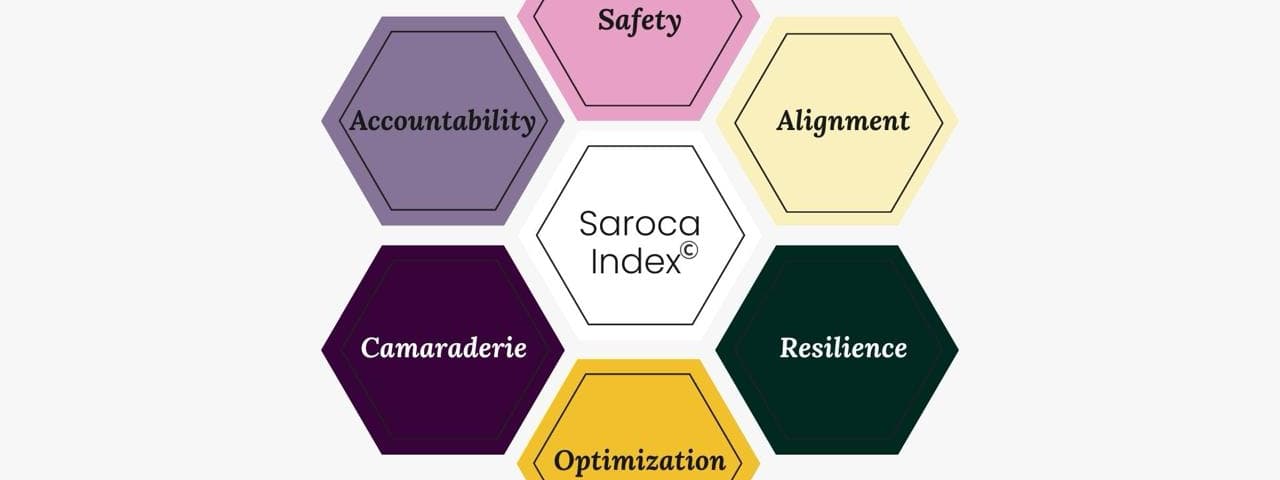
The six pillars
Safety. Whether people report problems early, or sit on them until they become crises. A low Safety score is often the earliest warning sign an organization has, well before anything shows up in the numbers.
Alignment. Whether both sides of a relationship actually agree on what success means, not just the CPA, but the pace, the priorities, and the risk tolerance each party is working with. Alignment is also about each individual aligning their work integrally with who they are a person.
Resilience. Whether a relationship can absorb a bad month, a missed target, or a hard conversation without both sides assuming the worst about each other.
Optimization. Whether the systems and habits in place are genuinely built for performance, or just built for the appearance of performance.
Camaraderie. Whether people feel like partners or like line items. A weak Camaraderie score predicts churn that has nothing to do with commercial terms and everything to do with how people are treated.
Accountability. Whether commitments made are commitments kept. A low Accountability score is frequently the precursor to a dispute nobody saw coming.
Each pillar is diagnostic on its own, but the real value is in the pattern across all six. A team or individual can score well on Optimization and Alignment and still be quietly bleeding because Camaraderie and Safety are both low. That's not a story a P&L will ever tell.
Why this matters for the affiliate side specifically
Affiliate marketing runs on relationships at scale: dozens or hundreds of partnerships, each with its own communication patterns, expectations, and history. That's exactly the environment where perception and behaviour drift apart without anyone noticing, because nobody's checking the six pillars, they're checking the CPA.
Operators and affiliate programs that run the Index get something most of the industry doesn't have: an early, structured read on where partnerships are strong and where they're quietly fraying. A team can be hitting its numbers and still be one Safety or Camaraderie gap away from losing top affiliates who simply stop reporting issues and leave instead. By the time that shows up as a churn statistic, the culture problem behind it has usually been building for a year or more.
This is also useful internally, not just partner-facing. Affiliate teams themselves run on trust between account managers, leadership, and the affiliates they support. The same six pillars that predict partnership breakdowns also predict internal turnover, burnout, and the kind of quiet disengagement that never makes it into an exit interview.
Culture, measured like everything else
The affiliate industry has gotten sophisticated at optimizing the mechanics of a partnership. What it hasn't gotten sophisticated at is optimizing the human system underneath all of it, the one running the entire time whether anyone's measuring it or not. The Saroca Index© turns that system from a vague cultural impression into six concrete, trackable scores, giving operators and affiliate teams a way to act before a relationship becomes a churn statistic instead of after.
So whether you want to measure yourself as an individual, your internal team, or your partnerships, take the assessment with a specific team in mind and discover the gaps that are holding you back from your greatest potential. The Saroca Index© is a diagnostic built for exactly this kind of high-volume, relationship-driven industry, and it's free to run during its beta period, now open through 30 September, 2026.